Guzheng music is written in jianpu (简谱) — the numbered notation that uses the digits 1 2 3 4 5 6 7 for the seven degrees of the scale. What makes a guzheng score look different from any other jianpu page is the layer of Chinese characters sitting above the numbers: a small set of marks naming which finger plucks the string, and what the left hand does to the note after it sounds.
Those marks are the part almost nobody documents in English. This guide covers all of them — the five fingering characters, the six technique characters, and the four ornaments — with what each one means, how it is drawn, and how it sounds.
Why guzheng repertoire is written in jianpu, not staff
The most common guzheng has 21 strings tuned to a major pentatonic scale. Read from the player’s side, the open strings give you 1 2 3 5 6 — do, re, mi, sol, la — repeating up the instrument, with coloured strings marking the octaves so the hand can find its place without looking.
That tuning is the whole argument. In jianpu the number is the string. Write 5 and the player’s hand already knows where to go, because a movable-do number maps onto a fixed physical position. Staff notation adds a step in the middle: read the absolute pitch, work out which string carries it in this piece’s tuning, then move. For an instrument retuned per piece, that middle step is pure overhead.
There is no string for 4 or 7. Those two degrees are produced by pressing the 3 and 6 strings on the left side of the bridge, raising each a step. This is why a page of guzheng jianpu looks so pentatonic, and why 4 and 7 usually arrive carrying a left-hand mark: they are not plucked notes so much as bent ones.
If the notation itself is new to you, start with the jianpu primer and come back.
The five fingering characters
Fingering marks name the right hand — which finger plucks the string. They are written directly above the number they apply to, and each is the first character of the finger’s full name (大指, 食指, 中指, 名指, 小指).
| Character | Pinyin | Finger | Typical use |
|---|---|---|---|
| 大 | dà | Thumb | Melody line, and the driving finger in 摇指 tremolo |
| 食 | shí | Index | Alternating patterns with the thumb |
| 中 | zhōng | Middle | Arpeggiated figures, lower voice |
| 名 | míng | Ring | Chord tones, less common alone |
| 小 | xiǎo | Pinky | Rare — most repertoire never asks for it |
These are instructions to the player, not sounds. Two identical notes marked 大 and 食 are the same pitch for the same duration; what changes is which finger gets there, and therefore what the hand is able to do next. That is the reason to write them at all — fingering is how a passage stays playable at speed.
The six technique characters
Technique marks name the left hand — what happens to the pitch after the string has been plucked. This is where most of the guzheng’s musical character lives.
| Character | Pinyin | Technique | What it does |
|---|---|---|---|
| 颤 | chàn | Vibrato | Repeated light pressure, oscillating the pitch |
| 上 | shàng | Portamento up | Press after plucking, bending the pitch upward |
| 下 | xià | Portamento down | Release a pre-pressed string, bending downward |
| 刮 | guā | Glissando | Sweep across strings |
| 揉 | róu | Kneading | Slow, deep pressure vibrato |
| 摇 | yáo | Tremolo (摇指) | Rapid re-articulation to sustain a long note |
The four ornaments
Ornaments are notated differently from the technique characters above: each is drawn as a graphic rather than a character, and two of them span more than one note.
| Ornament | Chinese | How it is drawn | Scope |
|---|---|---|---|
| Harmonic | 泛音 | Hollow circle above the note | One note |
| Arpeggio | 琶音 | Wavy vertical line to the left of the chord | One chord |
| Glissando | 刮奏 | Dashed arrowed line across the run | A span of notes |
| Grace notes | 装饰音 | Small notes before the principal | Attached to one note |
Harmonic (泛音) sounds an octave above the stopped note, thin and bell-like and much quieter than a normal pluck. The hollow circle sits above the notehead, so it reads at a glance as “this note, but ringing”.
Arpeggio (琶音) rolls the notes of a chord instead of sounding them together. The wavy line is drawn to the left of the stack rather than above any one note, because it describes the chord’s attack — the order the strings are struck in — not a property of a single pitch.
Glissando (刮奏) is the signature guzheng gesture: a sweep across consecutive strings, heard as a fast run rather than a smooth slide, because each string sounds discretely. It is a span, not a note mark. It has a start and a stop, and everything between them is part of the gesture.
Grace notes (装饰音) are small notes crushed in before the principal note, taking their time from it rather than from the bar. They are the ornament most likely to be dropped in transcription, and the one that most changes how idiomatic a passage sounds.
Reading a line of guzheng jianpu
Here is a short phrase built to show the marks working together. It is an illustration written for this guide, not a quotation from any particular piece:
刮  glissando — one sweep
| 5 6 1̇ 2̇ 3̇ 5̇ |

摇  tremolo — held 4 beats
| 6̇ - - - |
On a real page each mark is drawn directly above the notes it governs; written out in plain text here, each sits on the line above its own bar. Read it in this order, because it is the order the information arrives in:
- The numbers first.
5 6 1 2 3 5then6— a rising line through the pentatonic scale. - Then the dots above them. From
1̇onward every number carries a dot, putting it an octave up. Without the dots this is the same six digits in the middle of the instrument; with them it climbs. - Then the marks.
刮governs the whole first bar, so those six notes are one sweep of the hand, not six separate plucks.摇governs the6̇that follows. - Then the dashes after it. Three dashes hold that
6̇for four beats total — and it is摇that makes those four beats possible at all, since an unmarked plucked note would have died away long before.
What you should hear: a fast run up the strings that arrives on a high note, and then that note ringing on, shimmering slightly, while the sound is re-articulated too quickly to count.
Writing guzheng jianpu in DomiSol
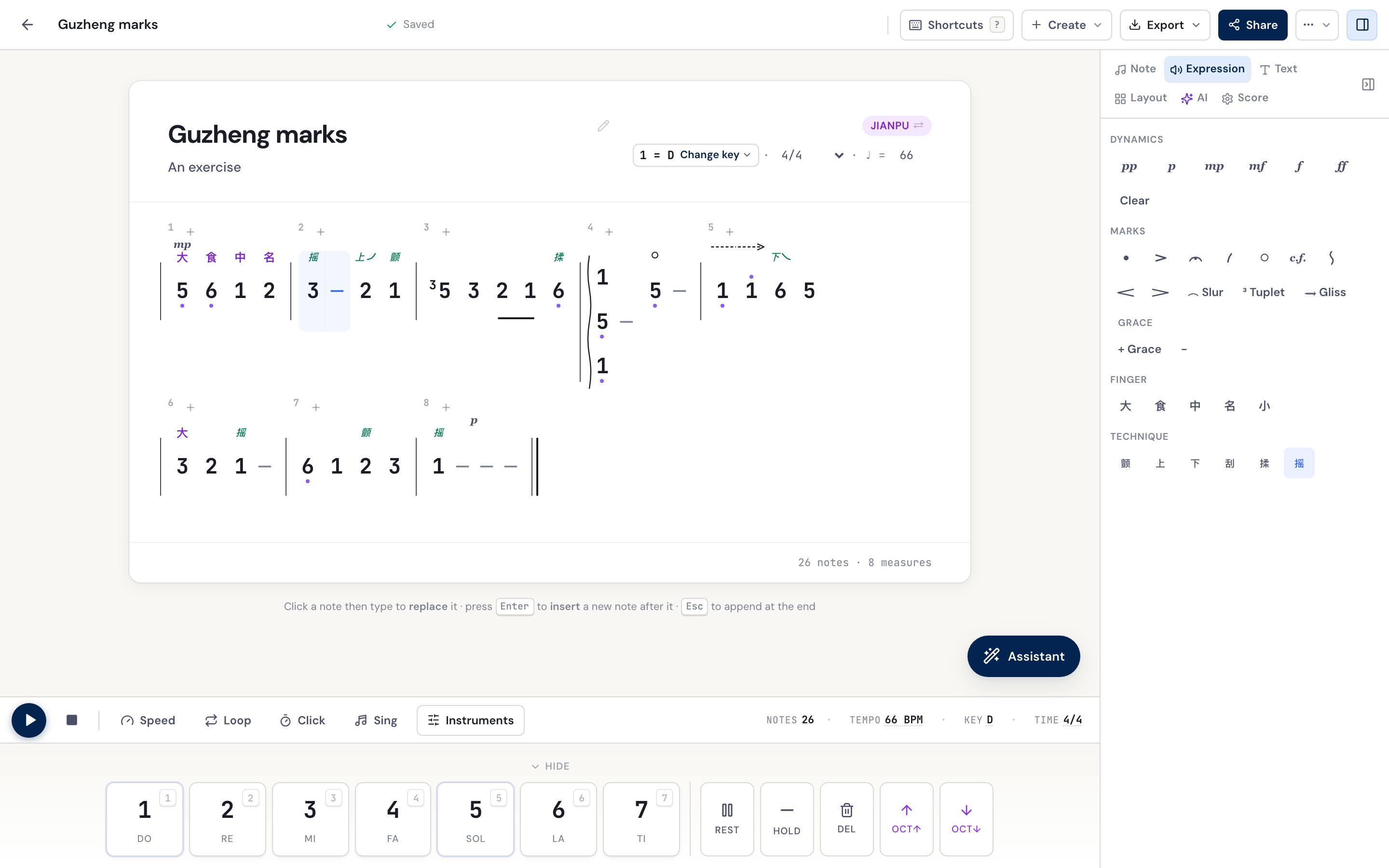
Once the template is on, the controls live in the Expression tab on desktop and on the Ornaments page of the keyboard on mobile. A few things worth knowing:
- Two staves in one click. The Layout tab’s “2 staves” preset names the parts Right hand and Left hand — the conventional guzheng layout — rather than making you add and rename parts yourself.
- The octave double is one click. Chord stacking places each extra pitch relative to the main note, and the picker offers three octave rows, so
1over1— the commonest guzheng chord there is — takes a single tap. Only a true unison is refused. - Glissando is placed like a slur. Click where it starts, click where it stops. Because it is stored as a span and drawn per note, it survives bar lines and line wrapping without you re-placing it.
- Both PDFs carry the marks. The jianpu PDF and the VexFlow staff PDF both render them, so you can hand a jianpu part to your guzheng players and a staff part to everyone else from the same score.
For how DomiSol compares to the alternatives, see the best tools for writing jianpu.
Which marks actually sound
Being straight about this, because it is the question people ask second:
| Mark | Drawn | Sounds on playback |
|---|---|---|
| 摇 tremolo | Yes | Yes — re-articulates across the note |
| 琶音 arpeggio | Yes | Yes — staggers the chord’s onsets |
| 刮奏 glissando | Yes | Yes — a fast run of discrete scale steps |
| 装饰音 grace notes | Yes | Yes — taken off the front of the note |
| 泛音 harmonic | Yes | No — visual only |
| 颤 揉 vibrato / kneading | Yes | No — visual only |
| 上 下 portamento | Yes, with curve | No — visual only |
| 大 食 中 名 小 fingering | Yes | No — performance instruction, not a sound |
The split is not arbitrary. The four that sound are timing effects: tremolo re-articulates, arpeggio staggers onsets, glissando is a run of discrete steps, grace notes steal a slice off the front of their own note. All four can be expressed by scheduling existing notes differently.
The silent ones are pitch-bend effects. Every voice in the playback engine is a polyphonic synth whose voices are allocated privately, so bending a note mid-sound would mean rebuilding the engine around one-shot monophonic voices. That is a real piece of work rather than a missing checkbox, which is why vibrato and portamento are drawn faithfully and left silent for now. Fingering, of course, will never make a sound — it tells the player what to do, not the score what to be.
Common mistakes when writing guzheng jianpu
- Writing 刮 as a mark on one note. The glissando is a span. Attaching it to a single note loses where the sweep ends, which is the half of the instruction the player actually needs.
- Putting the arpeggio line on the right of the chord. It belongs on the left. It describes the attack, and the attack happens before the chord, not after it.
- Holding a note with dashes and no 摇. Perfectly legal notation, and it means something specific: a note that is struck once and allowed to decay. If you wanted it to ring for four beats, the tremolo is not decoration, it is the instruction that makes it possible.
- Leaving the octave dots off. They feel redundant while you are writing, because you know which string you meant. They stop being redundant the moment the score leaves your hands — and octave dots are exactly where notation-recognition software makes nearly all of its errors, so a scan of an under-marked page comes back wrong in ways that are tedious to fix.
Where to go next
- Jianpu: read numbered notation (1 2 3 4 5 6 7) — the notation itself, from scratch
- DomiSol for jianpu musicians — what the editor does for instrumentalists
- The best tools for writing jianpu in 2026 — honest comparison of the alternatives
- Jianpu MIDI export — getting a jianpu score into a DAW
Frequently asked questions
- What notation does guzheng music use?
- Guzheng repertoire is written in jianpu (简谱, numbered notation) — the digits 1 2 3 4 5 6 7 for the seven scale degrees, with dots above or below for octave and underlines beneath for shorter durations. Staff notation is used mainly for conservatory ensemble parts and Western-style arrangements. For solo and traditional repertoire, jianpu is the original notation, not a translation of it.
- What do the Chinese characters above guzheng notes mean?
- They are two separate families. Fingering characters name which finger plucks the string: 大 (thumb), 食 (index), 中 (middle), 名 (ring), 小 (pinky). Technique characters name how the left hand shapes the note after it sounds: 颤 (vibrato), 上 (slide up), 下 (slide down), 刮 (glissando), 揉 (kneading), 摇 (tremolo). Both sit above the number they apply to.
- What is 摇指 (yaozhi) and how is it written?
- 摇指 is the rapid back-and-forth thumb tremolo that carries most sustained guzheng melody — the instrument has no bow, so a long note is held by re-articulating it many times per second. It is written as 摇 above the note. In DomiSol it is one of the marks that actually sounds on playback: the note is re-articulated across its full written duration rather than being drawn and ignored.
- How do you write a guzheng glissando?
- The 刮奏 glissando (the sweeping run across the strings that opens so much guzheng repertoire) is written as a line drawn across the notes it spans, not as a mark on a single note. In DomiSol it is a span: you mark where it starts and where it stops, and the dashed arrowed line is sliced per note, so it survives bar lines and line wrapping. On playback it sounds as a fast run of discrete scale steps.
- Can I write guzheng notation on a computer?
- Yes. DomiSol is a free web-based jianpu editor with the guzheng marks built in — fingering, techniques, harmonics, arpeggio, glissando and grace notes — rendered into both the jianpu PDF and the staff-notation PDF. Turn on the Chinese notation template — Score tab, or the 'Guzheng marks' button on the Expression tab — and the guzheng controls appear. Most general-purpose notation software either cannot render jianpu at all or needs a conversion plugin that drops the Chinese-character marks.
- Why does guzheng jianpu mostly use 1 2 3 5 6?
- The most common guzheng has 21 strings tuned to a major pentatonic scale, so 1 2 3 5 6 (do re mi sol la) are open strings and fall under the fingers directly. No string is assigned to 4 or 7 (fa and ti); those pitches are produced by pressing the 3 and 6 strings on the left side of the bridge to raise them a step. That is why they appear less often and usually carry a left-hand mark.