A reader wrote to us last week with a short, precise observation: Indonesian numerical music notation is similar to jianpu, he said, with some modification.
He was right. And the modifications turned out to be the kind you only notice if you read the notation yourself — which is why we had got some of them wrong without knowing.
What not angka is
Not angka — also written notasi angka, and sung as solmisasi — is the
Indonesian form of numbered musical notation. The seven degrees of the scale
are written 1 2 3 4 5 6 7, with dots above or below for octave and lines
beneath for shorter durations. If you have read Chinese jianpu, that will sound
exactly like jianpu, and it nearly is: both descend from the same
nineteenth-century Galin-Paris-Chevé system, and a reader of one can mostly
read the other.
It is the everyday notation of Indonesian church and school music. Congregations sing from it, choirs rehearse from it, and children learn to read music through it. A great deal of music exists in this notation and nowhere else.
But it is not a dialect of jianpu. It is a parallel tradition with its own conventions, and software that treats the two as identical prints one tradition’s music in the other tradition’s hand. That is a real error, not a cosmetic one — in the same way that a French score printed with German terminology would be readable, and wrong.
The four differences
| Chinese jianpu | Not angka | |
|---|---|---|
| Duration beams | below the number | above it |
| Key statement | 1 = C | Do = C |
| Sharp (kres) | ♯ before the number | a / struck through the digit |
| Flat (mol) | ♭ before the number | a \ struck through the digit |
| Seventh degree | ti | si |
The beams are the one you notice across a room. In Chinese jianpu the duration lines sit under the digits; in not angka they sit above them. Nothing about the music changes, but the whole page looks different, and to a reader who grew up with one, the other looks like a typo repeated a thousand times.
The struck accidental is the one software gets wrong. In not angka a raised
semitone — kres — is a forward slash drawn through the number, and a
lowered one — mol — is a backslash through it. People approximate this in
plain text as 1/ or /1, and neither is quite right: the stroke crosses the
digit rather than standing beside it. That is precisely why it has to be drawn
rather than typed, and why it has historically needed a special font.
si, not ti is the smallest difference and the one a singer hears most. It is what you are told out loud in a rehearsal room.
Writing it in DomiSol
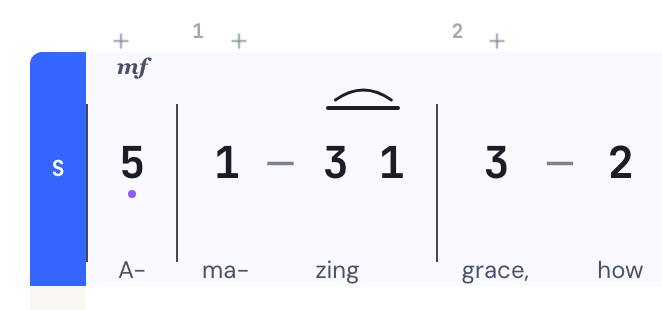
Open the Score tab, find Template, and choose Solmisasi. You can also pick it when you create a score.
That one choice sets all four conventions together — beams above, Do =,
struck accidentals, and si for the seventh — and switches the score to
numbered notation. They belong together, so they are one decision rather than
four switches to hunt down.
Switching back to Standard reverts every one of them. Nothing is rewritten when you do: a template changes how the music is drawn, never what is stored, so you can move between conventions as often as you like and lose nothing.
If you want only the beam side and none of the rest — some scores do mix — that setting still stands on its own under Score → Jianpu beams.
The full reference is in Solfa, jianpu and the key.
No font to install
There is an existing tool for this: the Solmisasi plugin for MuseScore. We owe it a straightforward debt — its documentation, together with Indonesian teaching material, is what settled the two slash directions for us, and we would rather say so than pretend we worked it out alone.
It does a different job, though. It annotates existing staff notation with
numbers above the stave; it cannot engrave not angka, and you cannot write in
it. And to see the accidentals as intended you must install the Parnumation
font and configure MuseScore’s text styles by hand — without that, they appear
as a literal /1.
DomiSol draws the stroke itself. There is nothing to install, it scales with the digit, and it comes out the same in the editor, in an exported PDF, and on a phone.
Photographing a page
If the music you want already exists on paper, you do not have to retype it. Photograph the page — or upload a PDF — and DomiSol turns it into an editable score.
For angka pages it reads the beam position directly off the page, and when it
also finds a Do= key statement it turns the Solmisasi template on for you.
One honest limit: we have not yet measured recognition quality on Indonesian hymnal pages specifically. Five are in our test corpus, none of them transcribed against ground truth, so we can tell you it works without telling you how well. That measurement is on the list, and we would rather say this plainly than quote a number we have not earned.
Tell us if it still looks wrong
Some Indonesian scores do print ♯ before the number in the ordinary way.
That is why the struck form sits behind a template rather than being forced on
every numbered score — we would rather offer the convention than impose it.
If something here does not match the notation you actually read, please say so. This whole change exists because one reader took the trouble to write, and the part we most needed telling was the part we did not know we had wrong.
DomiSol is free to write and share in, permanently. If you write not angka, we would like to hear how it holds up.
Further reading: Solfa, jianpu and the key · What is jianpu?
Frequently asked questions
- What is not angka?
- Not angka (also written notasi angka, and sung as solmisasi) is the Indonesian form of numbered musical notation. The seven scale degrees are written 1 2 3 4 5 6 7 with dots above or below for octave, exactly as in Chinese jianpu — but four conventions differ: duration beams are drawn above the number rather than below it, the key is stated Do = C rather than 1 = C, sharps and flats are struck through the digit instead of placed before it, and the seventh degree is called si rather than ti.
- Is not angka the same as jianpu?
- They share a common ancestor — the Galin-Paris-Chevé system — and the same core idea, so a reader of one can mostly read the other. But the differences are visible on every line: an Indonesian hymnal draws its duration beams above the numbers, and a Chinese score draws them below. Software that treats them as identical prints one tradition's music in the other tradition's hand.
- How do I write not angka on a computer?
- In DomiSol, pick the Solmisasi template — Score tab → Template, or when you create a score. It sets all four Indonesian conventions at once and switches the score to numbered notation. It is free, and there is no font to install.
- How are sharps and flats written in not angka?
- A sharp (kres) is a forward slash struck through the digit, and a flat (mol) is a backslash struck through it. This is different from Chinese jianpu, which places a ♯ or ♭ before the number. DomiSol draws the stroke directly, so it needs no special font — unlike the MuseScore Solmisasi plugin, which requires the Parnumation font to be installed and configured by hand.
- Can DomiSol read a photo of an angka page?
- Yes. Photograph or upload a page and DomiSol recognises it as an editable score. It reads the beam position off the page, and when it also finds a Do= key statement it turns the Solmisasi template on for you.
- Does DomiSol cost anything?
- Writing, playing and sharing your own scores is free permanently, with no card. Paid plans cover the AI credits and the print-ready exports.