Somebody hands you a Chinese songbook, a church hymnal from Taiwan, or the erhu part for a Chinese orchestra, and there is not a staff line on the page. What you are looking at is almost certainly jianpu, the numbered notation, and it takes about ten minutes to learn to read.
“Chinese music notation” can mean two other things as well. Gongche writes the notes as Chinese characters and survives in opera. Jianzipu is the tablature of the guqin, and it does not write notes at all. This guide shows what each looks like, how to tell them apart, and how Chinese musicians sing the notes.
Jianpu (简谱): the numbers
Jianpu means “simplified notation”. The seven notes of the key are the numbers 1 to 7, and the line at the top of the page says which pitch 1 is.
1 = D   4/4
| 1  2  3  4 | 5  -  -  - |
| 5  6  7  1̇ | 1̇  -  -  - |
The rest of it fits in a few lines:
- Octaves. A dot above a number raises it an octave, a dot below lowers it, and two dots mean two octaves.
- Length. A plain number is one beat. A line under it halves it, two lines quarter it. A dash after it adds a beat. A dot after it adds half its length, as in staff notation.
- Rests.
0is a rest, with the same lines and dots for its length. - Accidentals.
#4is a raised fourth andb7a lowered seventh, written before the number.
Because 1 is always the key note, jianpu is movable do: a song moved from D to F is written with exactly the same numbers and a new line at the top. The full rules, with a worked example, are in our guide to reading jianpu.
Jianpu came from a French system for teaching singing, worked out in the 1800s, and over the 20th century it replaced gongche as the everyday notation of Chinese music. It is what you will find in folk and pop songbooks, school music, many church hymnals, and the parts for Chinese instruments: erhu, dizi, pipa and guzheng. Close relatives of it are used in Japan and in Indonesia, where it is called not angka.
How Chinese musicians sing it
When Chinese musicians sight-sing jianpu, they do not say the numbers. They sing them as do re mi, and because 1 is always the key note, 1 is always sung do. Chinese music teaching calls this 首调唱名法 (shǒudiào chàngmíngfǎ), the “key-note naming method”, which is movable do. Naming the notes by fixed pitch, as staff readers in some conservatories do, is 固定调唱名法.
| Jianpu | Sung | Written | Pinyin | Tonic solfa |
|---|---|---|---|---|
| 1 | do | 哆 | duō | d |
| 2 | re | 来 | lái | r |
| 3 | mi | 咪 | mī | m |
| 4 | fa | 发 | fā | f |
| 5 | sol | 嗦 | suō | s |
| 6 | la | 拉 | lā | l |
| 7 | si | 西 | xī | t |
The characters only spell the sounds, so books differ: re is also written 瑞, sol 唆 or 索, la 啦. The one real difference from tonic solfa is the seventh note, sung si in Chinese as in Italy, France and Spain, and ti in solfa.
Gongche (工尺谱): the characters
Before jianpu, Chinese music was written in gongche, named after two of its characters, 工 and 尺. Each note is a character, written in a column beside the words and read top to bottom, with the columns running right to left. In the reading most modern transcriptions use, 上 is do:
| Gongche | Pinyin | Jianpu |
|---|---|---|
| 合 | hé | 5 with a dot below |
| 四 | sì | 6 with a dot below |
| 一 | yī | 7 with a dot below |
| 上 | shàng | 1 |
| 尺 | chě | 2 |
| 工 | gōng | 3 |
| 凡 | fán | 4 |
| 六 | liù | 5 |
| 五 | wǔ | 6 |
| 乙 | yǐ | 7 |
The beat is shown by small marks beside the characters, called 板 (bǎn) for the strong beat and 眼 (yǎn) for the weaker ones. Gongche is still read in Kunqu and Cantonese opera, and in some ritual and temple music.
It varies more than jianpu does. Some traditions write 士 for 四, older sources take 合 rather than 上 as do, and 凡 and 乙 are tuned between the Western notes in some regional styles. A gongche score is best read with a guide from its own tradition. Much of the old repertoire has been published again in jianpu, which is usually the easier way in.
Jianzipu (减字谱): the guqin’s tablature
The guqin, the seven-string zither of scholars, has a notation of its own, over a thousand years old. Jianzipu means “reduced-character notation”: each sound is one compound character built from pieces of others. One piece says which finger (大, “big”, is the thumb), others say which string, where on the string to stop it, and how to pluck.
So a jianzipu score records what the hands do, not the notes. Pitch follows from the tuning and the finger positions. Rhythm is barely written at all: players work it out from the phrasing, a teacher, or a recording, a process called 打谱 (dǎpǔ). Modern editions often print jianpu or staff notation under the tablature for that reason.
Which one are you looking at?
| On the page | It is |
|---|---|
Rows of numbers 1 to 7, with dots, lines under them and dashes, and 1 = G at the top | Jianpu |
The same, with the lines above the numbers and Do = G at the top | Indonesian not angka, a close relative |
| Columns of characters such as 上 尺 工 六, with small marks beside them | Gongche |
| Dense compound characters, one per sound, with no numbers | Guqin jianzipu |
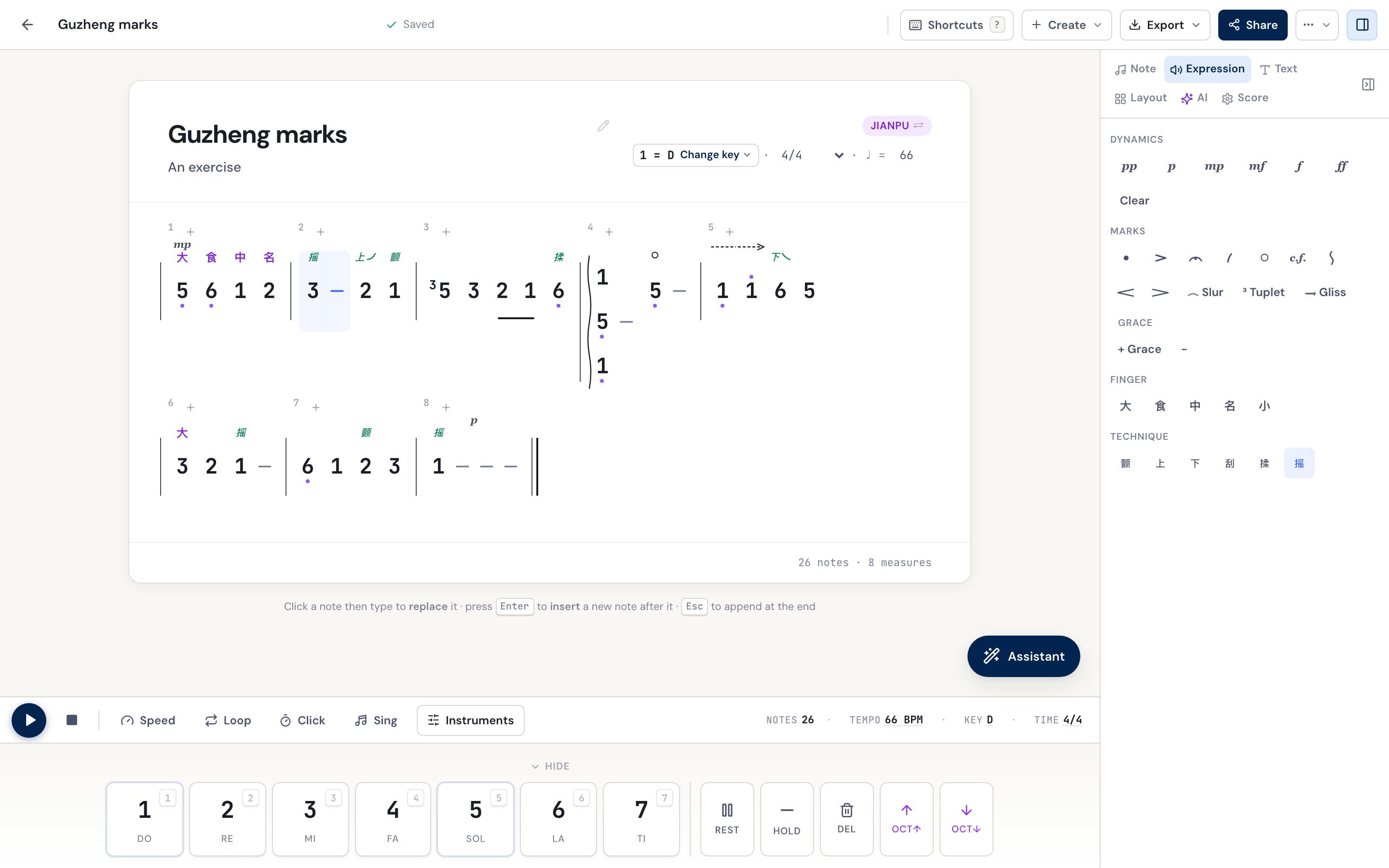
| Numbers with characters such as 摇 or 刮 above them | Guzheng jianpu |
Writing Chinese music in DomiSol
DomiSol writes jianpu as the notation itself, not as numbers printed under a
staff. You type 1 2 3, the key is printed as 1 = D, and the octave dots,
the lines under short notes and the dashes are drawn the way a Chinese
songbook draws them.
- Words under the notes, a character to a note, or held over several.
- The 中文 Chinese template (Score → Template) adds the guzheng’s fingering and technique characters. See guzheng marks.
- Free meter for songs with no fixed beat (散板): the score prints サ where the time signature would go, and each bar is as long as its phrase.
- A photo of a printed jianpu page comes back as a score you can edit, transpose and play.
- The same score in tonic solfa, or exported as staff notation, for a choir or an accompanist who reads those.
DomiSol does not write gongche or guqin tablature. If your music is in either, the usual route is the one modern editions take: transcribe it into jianpu, and write that.
Related reading
- How to read jianpu: numbers, dots, lines and dashes, with a worked example
- Guzheng notation in jianpu: fingering, techniques and ornaments
- Jianpu in a minor key: when the song centres on 6
- Staff notation to jianpu: converting a score you already have
- DomiSol for jianpu musicians: the editor, for Chinese music
- The jianpu editor: write jianpu in the browser
Frequently asked questions
- What is Chinese music notation called?
- Most Chinese sheet music today is jianpu (简谱, jiǎnpǔ, "simplified notation"), a numbered notation in which 1 to 7 are the seven notes of the key. Two older notations are still in use: gongche (工尺谱), which writes the notes as Chinese characters, and jianzipu (减字谱), the tablature of the guqin.
- How do you read Chinese sheet music?
- If it is written in numbers, it is jianpu. 1 is the key note, and the line at the top, such as 1 = D, says which pitch that is. A dot above a number raises it an octave and a dot below lowers it. A line under a number halves its length, a dash after it adds a beat, and 0 is a rest.
- How do you say do re mi in Chinese?
- Chinese musicians sing the numbers of jianpu as do re mi fa sol la si, with si for the seventh note where tonic solfa says ti. The sounds are written with characters chosen for how they sound, commonly 哆 来 咪 发 嗦 拉 西 (duō lái mī fā suō lā xī), and spellings vary between books.
- What is gongche notation?
- Gongche (工尺谱, gōngchěpǔ) is an older Chinese notation that writes each note as a character: 上 尺 工 凡 六 五 乙 for the seven notes, with 合 四 一 for the three below. It is written in columns beside the words, with marks for the beat. Kunqu and Cantonese opera still use it, but jianpu replaced it for most music in the 20th century.
- Is guqin music written in jianpu?
- Not traditionally. The guqin has its own tablature, jianzipu (减字谱), in which each compound character says which finger, which string, where on the string, and which technique. It records the hand's actions rather than pitch or rhythm, and players work the rhythm out in a process called dapu. Modern editions often print jianpu or staff notation beside it. The guzheng, a different instrument, is read from jianpu.