There is an assumption buried in almost every piece of music software ever written: that music is written on five lines.
It is a reasonable assumption if you learned music in Europe or North America. It is wrong about most of the people who read music.
The arithmetic
Jianpu (简谱, numbered notation, 1 2 3 4 5 6 7) is the standard way music is written across China, Taiwan and Indonesia, and it is also used in Japan and Myanmar. Tonic solfa (d r m f s l t) is the working notation of church and school choirs across Nigeria, Ghana, Kenya, Tanzania, South Africa, and much of the Caribbean and the Pacific.
Nobody has counted properly, and anyone who gives you a precise figure is guessing. But the order of magnitude is not in doubt: between them, these two systems are read by well over a billion people. Staff notation’s readership is large, and it is also heavily concentrated among the formally trained.
So the notation that most music software treats as the notation is, globally, a minority one.
What “supported” usually means
Most notation software will tell you it supports solfa or jianpu. Look closer and the support is nearly always one of three things:
An export format. You write in staff notation and it prints numbers underneath. Fine if you already read staff. Useless if you do not, because you cannot write anything without first learning the notation you were trying to avoid.
A plugin. Someone in the community built a converter. Often good work — MuseScore’s Numbered Notation plugin is genuinely useful — but it sits on top of a program whose internal model is still staff notation, and it shows the moment you want to edit rather than convert.
A font. Yes, really. There are workflows built on typing into a word processor with a special font, and people ship real hymn books this way.
What almost nothing does is treat these notations as the thing you write in. The distinction sounds academic until you try to work.
Where it actually hurts
Consider a specific person, because the general case is too easy to wave away.
A choir director in Kumasi has forty singers who read solfa fluently and staff notation not at all. She wants to arrange a hymn in four parts. Her options today:
- Write it by hand. Which is what most people do. It takes hours, it cannot be transposed without rewriting, and when a singer loses their copy there is one master and a photocopier.
- Learn staff notation, use standard software, and export solfa. Months of learning to use a tool for a notation she already knows.
- Use a word processor. Tab stops and a monospace font. This is not a joke; it is extremely common.
Each of those is a tax charged for reading the wrong notation. And the tax is not small: option 1 is the one most people pick, which means the arrangement lives on paper, cannot be shared, and dies when the paper does.
The part that keeps surprising us
We build DomiSol, an editor where solfa and jianpu are the notation you write in — not a conversion applied on the way out. So we see who turns up.
About three quarters of the people who write music in it are in emerging markets. Nigeria is the single largest, then India, then Ghana, South Africa, Indonesia, Madagascar, Uganda, Kenya. Not a long tail — the main body.
That was not the plan. It is simply who needed this.
And it comes with a second fact that took us longer to understand. Those users write music, share it, export it, come back — and they almost never pay. For a long time we read that as a price objection, because that is the obvious reading.
It mostly is not. Card payments from Nigeria and Kenya frequently cannot complete an international charge at any price — domestic-only card schemes, foreign-exchange caps that are sometimes zero. The checkout button does not fail because the price is too high. It fails.
Movable do, and why it is not a lesser system
There is a persistent idea that numbered and syllable notations are simplified versions of staff notation — training wheels for people who have not learned the real thing.
They are not simplified. They are different, and in one specific way they are better.
Both are movable do systems: a note is named by its position in the key rather than by absolute pitch. In solfa, d is whatever note the piece centres on. In jianpu, 1 is.
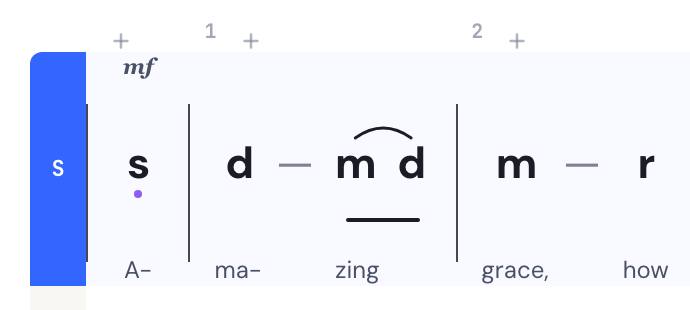
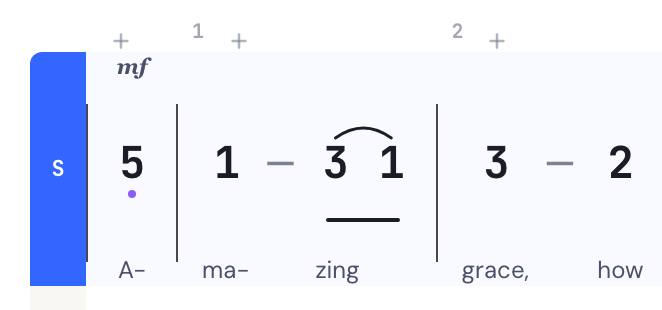
The consequence is that transposition is free. A melody is written once and sung in any key without rewriting a single character — which is exactly what a choir needs when the arrangement sits too high for the altos, or when the only available keyboard player is more comfortable in F.
In staff notation, transposing means rewriting every note. In solfa it means changing one line at the top of the page.
Anyone who has run a rehearsal knows which of those they would rather do.
What we think this means
Three things, and we would rather be argued with than agreed with:
The notation is not the beginner’s version. It is the working notation of enormous musical traditions, used by professionals, and it deserves software built for it rather than adapted to it.
“Global” software usually means “works in English.” It rarely means the payment rail reaches you, or that the notation you read is a first-class citizen, or that it runs on the phone that is your only computer.
The gap is a tooling gap, not a demand gap. People are writing this music. They are doing it by hand, in Word, on paper that gets lost. The demand has been there the whole time.
Have a page of music in front of you?
Photograph it — a hymnbook, a handwritten part, a printed 简谱 page — and we'll show you what's on it in your browser, before you sign up for anything.
If you read one of these notations
DomiSol is free to write in, play back and share, and it stays that way. There is a solfa editor and a jianpu editor, they are the same program in two notations, and you can switch a score between them with one tap.
If you are starting from something you already have, the converters take a photo, a PDF, a staff score, MusicXML or MIDI.
And if you read jianpu, we recently learned to write minor keys and Chinese modes properly — 6 = A rather than 1 = C — because a musician wrote to tell us we had it wrong. That is generally how this works.
Frequently asked questions
- Do more people read solfa and jianpu than staff notation?
- Almost certainly, though nobody has counted properly. Jianpu is the standard notation across China, Taiwan and Indonesia, and is also used in Japan and Myanmar. Tonic solfa is the working notation of church and school choirs across Nigeria, Ghana, Kenya, Tanzania, South Africa and much of the Caribbean and Pacific. Between them that is well over a billion people, against a Western staff-reading population that is large but smaller and heavily concentrated in formal training.
- Why doesn't notation software support solfa and jianpu properly?
- Because almost all of it was built where staff notation is the default, and support for anything else was added later as an export format or a plugin. That means the software's internal model is staff notation, so solfa or jianpu is something it converts to on the way out rather than something you can write in. The difference shows up the moment you try to edit.
- What is movable do?
- A system where notes are named by their position in the key rather than by absolute pitch. In solfa, doh is whatever note the key centres on; in jianpu, 1 is. It means a melody is written once and can be sung in any key without rewriting a note, which is why it suits choirs who transpose to fit their singers.
- Is tonic solfa outdated?
- No. It is British in origin — John Curwen popularised it in the 1840s — and is now read far more outside Britain than inside it. It remains the primary notation for choral singing across much of Africa, and is taught in schools throughout the Commonwealth and beyond.
- Can I write solfa or jianpu on a phone?
- In DomiSol, yes — it runs in any mobile browser. This matters more than it sounds: in the markets where these notations dominate, a phone is often the only computer someone has, and desktop-only notation software is simply unavailable to them.